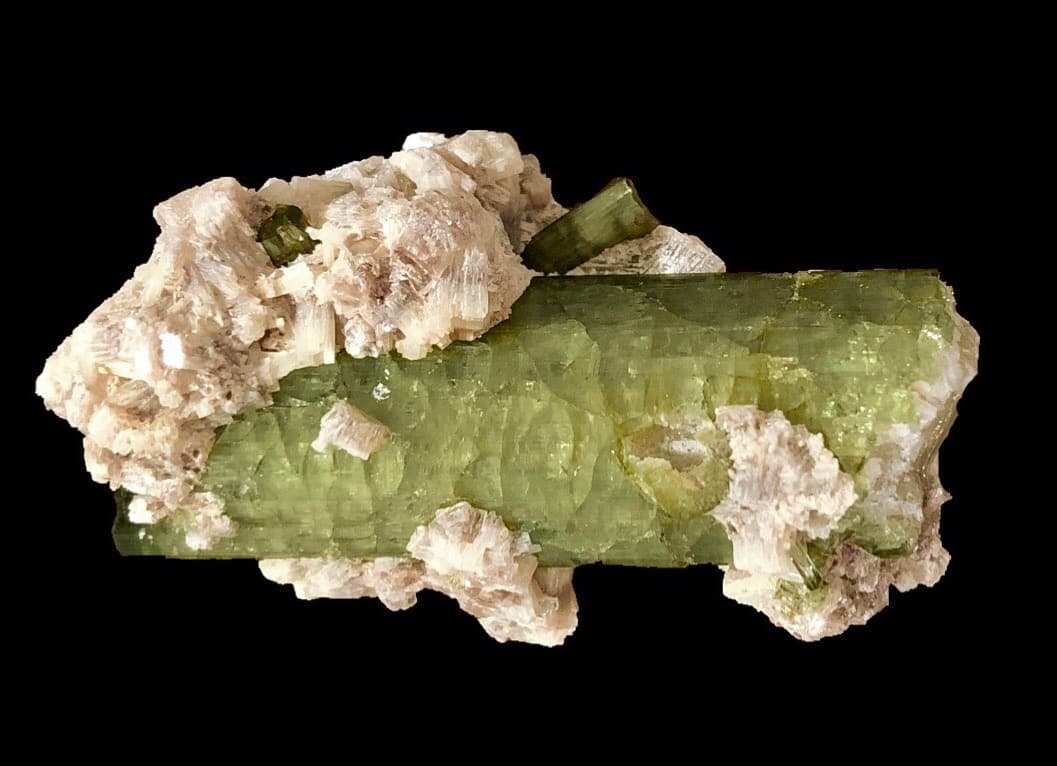
Tourmaline, a mineral of colors, is colorful, yet complex. Specimens of tourmaline exhibit a wide variety of colors, yet maintain a complex chemical structure and composition. What creates the unique attributes of Tourmaline?
Tourmaline, composed primarily of aluminum, iron, magnesium, other earth metals, and silicon, is a cyclosilicate mineral. Owing to the large amounts of elements that comprise Tourmaline, the mineral has a complex chemical composition with many possible variations.
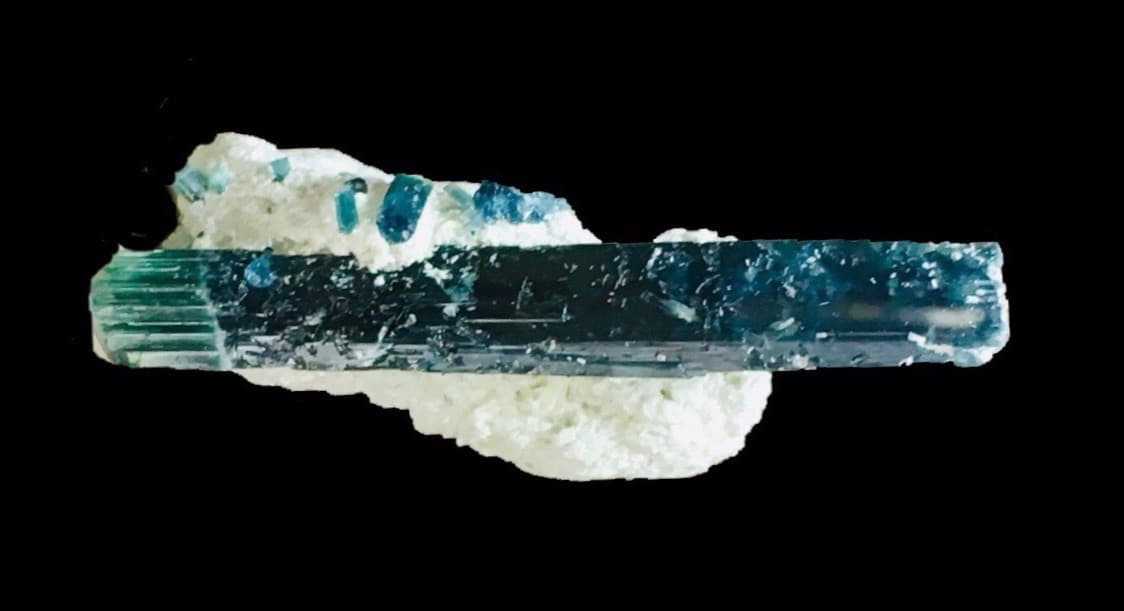 Indicolite crystal on a white albite matrix
Many varieties of Tourmaline are defined by marked deviations in color stemming from varying chemical compositions. For instance, the pronounced blue of Indicolite (shown above) originates from a small portion of Iron atoms substituted into vacancies of the mineral's molecular structure. Other varieties of Tourmaline receive their distinctive hue from unique chemical impurities and substitutions.
The complex chemical composition and formation of Tourmaline creates the radiating tones of crystals. Many varieties arise as a result of the varying chemical compositions.
As the chemical composition of the mineral creates the color of minerals, it is also the source of a multitude of other properties.
The hardness, fracture, cleavage, and luster also owe to the unique, complex silicate arrangement of Tourmaline crystals. The many elements creating the compound combined create the multicolored, complex substance known as Tourmaline.
References
"Tourmaline", Encyclopedia Brittanica, 22 November 2019 https://www.britannica.com/science/tourmaline-mineral ↗
"Tourmaline", Mindat, Mindat.org ↗, 22 November 2019 https://www.mindat.org/min-4003.html ↗